
 Christoper Macaranas
If your business is not mentioned or cited by these AI systems, you are already invisible to a growing audience.
That is where LLM Optimization (LLMO) comes in.
In this guide, you will learn step by step what LLM Optimization is, why it matters, and how it helps your brand get remembered, trusted, and cited by AI in 2026.
No technical language. No confusing theories. Just clear, practical insight you can understand and act on.
What Is LLM Optimization (LLMO)?
LLM Optimization, also known as Large Language Model Optimization, is the process of structuring your content so AI systems can easily:
- Discover it.
- Understand it.
- Trust it.
- Recommend or cite it in answers.
Unlike traditional SEO, where the goal is to rank on Google and get clicks, LLMO focuses on visibility inside AI-generated responses.
When someone asks:
“Who is the best SEO specialist in the Philippines?”
“Which company should I trust for digital growth?”
AI tools don’t show ten blue links. They give one clear answer. LLMO helps ensure the answer includes you.
Why LLM Optimization Matters More Than Ever in 2026
You may already notice this shift:
- Fewer people click on search results.
- More users trust AI summaries.
- Many searches now end without a website visit.
This is called zero-click search, and it is growing fast.
Here’s the good news:
While traditional clicks are decreasing, AI referral traffic often converts better because users already trust the recommendation.
If AI mentions your brand positively, users arrive ready to act.
LLM Optimization ensures:
- Strong AI search visibility.
- Higher brand trust.
- Better-quality leads.
- Long-term authority, not short-term rankings.
LLMO vs Traditional SEO: What’s the Difference?
Traditional SEO focuses on:
- Keywords.
- Backlinks.
- Page rankings.
- Click-through rates.
LLMO focuses on:
- AI-readable content.
- Entity optimization.
- Semantic meaning.
- Trust and authority.
- AI citation strategy.
Instead of asking,
“Can I rank #1 on Google?”
LLMO asks,
“Will AI remember me and recommend me?”
Both matter, but in 2026, AI-first visibility wins.
How AI Chooses Content to Cite
AI systems don’t think like humans, but they do follow patterns.
They prefer content that is:
- Clear and structured.
- Easy to summarize.
- Consistent across the web.
- Backed by real expertise.
- Written in natural, conversational language.
This is why AI content structuring is critical.
AI does not reward noise.
AI rewards clarity.
The Core Pillars of LLM Optimization
1. AI-Readable Content
Your content must be easy for machines to scan and extract meaning from.
This means:
- Clear headings (H1, H2, H3).
- Short paragraphs.
- Bullet points and tables.
- Direct answers near the top.
Think of it as writing for humans and AI at the same time.
2. Entity Optimization
AI does not just read words; it recognizes entities.
An entity can be:
- A person.
- A brand.
- A company.
- A service.
Entity optimization helps AI understand:
- Who you are.
- What you do.
- Where you operate.
- Why you are credible.
This includes:
- Consistent brand mentions.
- Clear author profiles.
- Association with known topics and industries.
- Knowledge graph SEO signals.
3. Semantic SEO for AI
AI does not rely on exact keywords alone.
It understands context and meaning.
That’s why semantic SEO for AI matters more than keyword stuffing.
Instead of repeating:
“LLM Optimization”
You naturally include related ideas such as:
- AI Optimization.
- LLM SEO.
- Generative AI Optimization.
- Conversational search optimization.
- AI answer optimization.
This tells AI:
“You fully understand this topic.”
4. Trust and E-E-A-T Signals
AI systems strongly favor content that shows:
- Experience.
- Expertise.
- Authoritativeness.
- Trustworthiness.
This means:
- Real insights, not generic text.
- Clear ownership of content.
- Updated, accurate information.
- Transparent intent.
Trust is the currency of AI recommendations.
How LLM Optimization Helps Your Business or Brand Grow
LLMO is not just a theory. It delivers real-world benefits.
Better AI Brand Recognition
Your name becomes familiar to AI systems, not random.
Increased AI Referral Traffic
Users come from AI tools already interested and informed.
Stronger Authority
You are positioned as a trusted expert, not just another website.
Long-Term Visibility
Even if search algorithms change, AI memory persists.
In competitive industries like business and digital services, LLM Optimization puts your brand in front of high-intent users by making it a trusted AI recommendation, not just another search result.
Key LLM Optimization Strategies You Should Use
Answer-First Content
Start your pages with clear, short answers (50–100 words).
This helps AI extract and reuse your content.
Conversational Format
Use natural language that mirrors how people ask questions.
Consistent Brand Mentions
Your name, service, and location should align across platforms.
Structured Pages
Use headings, lists, and summaries so AI can scan easily.
AI-Friendly Technical Setup
Your content should be accessible, crawlable, and text-based.
Recommended Tools for LLM Optimization (LLMO)
These tools help you improve AI visibility, entity recognition, semantic content structure, and performance tracking in AI search. They are not just SEO tools; they support AI-first strategies.
Content Structuring & Semantic Tools
1. Surfer SEO / Content Editor
- Helps structure content for semantic relevance
- Suggests related terms, LSI keywords, and entity clusters.
- Useful for AI-readable content planning.
2. Clearscope / MarketMuse
- Provides context optimization and topic modeling
- Ensures comprehensive semantic coverage.
3. Frase
- Great for question-based outlines.
- Matches content to user intent + AI patterns.
Analytics & AI Referral Tracking
4. Google Analytics + Custom Segment Tools
- Can capture referral traffic from AI sources.
- Use custom reports to track AI-driven visits.
5. Semrush Brand Monitoring / Trends
- Tracks brand mentions across the web that feed entity signals.
- Great for measuring brand authority.
6. Ahrefs Brand Radar
- Monitors where your brand appears across the web.
- Helps feed AI entity signals from high authority sites.
AI-Focused Tools & Plugins
7. Yoast / RankMath with llms.txt support
- Some plugins now support or let you generate llms.txt summaries.
- Ensures your site provides AI-friendly content signals.
8. Widget/Markup Tools (Schema Plugins)
- Add structured data (FAQ, HowTo, Q&A, Person, Organization).
- Helps AI better understand your entities.
9. Semantic/Entity Tools (e.g., Ontology/Taxonomy Plugins)
- Tools that help you define semantic context and related terms.
- Good for deep entity and topic modeling.
AI Testing & QA Tools
10. Perplexity / ChatGPT / Gemini (as research tools)
- Test how your content is cited.
- See what AI answers look like.
- Identify gaps and optimization opportunities.
11. Writesonic / Jasper / AI Assistants
- Can be used to generate AI-friendly summaries.
- Helps refine your content for conversational queries.
Technical Tools
12. Screaming Frog / Deep Crawl
- Check crawlability and technical issues that impact content discoverability.
13. Server Access / llms.txt Generators
- Tools that let you create and host llms.txt (e.g., custom scripts or plugins).
Why Each Tool Matters
| Tool Type | Why It Helps LLMO |
| Content Structuring | Supports AI-readable organization and semantics |
| Analytics | Measures AI referrals and citation impact |
| AI Tools | Help you test what AI outputs you’re getting |
| Entity / Brand | Builds entity strength and recognition |
| Technical Tools | Ensures AI bots can access and process content |
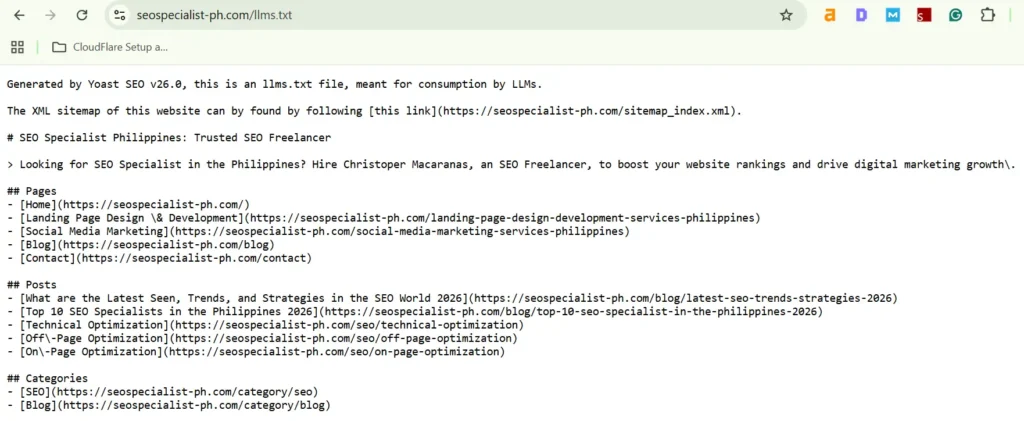
Sample llms.txt File (Fully Optimized)
Use this file to help AI tools understand your site’s core topics, brand identity, and content purpose.
Place it at your domain root:
https://seospecialist-ph.com/llms.txt
How to Use llms.txt
- Upload to Your Root Domain
Example: https://seospecialist-ph.com/llms.txt - Link It in Your Sitemap
Add to your XML sitemap to help discoverability. - Mention It in Your LLMO Guide
Include a section explaining what it is and why it matters. - Update Quarterly
Keep it fresh with new content series and brand positioning.
Measuring LLM Optimization Success
Traditional SEO metrics are not enough.
You should also track:
- AI mention frequency.
- Brand visibility in AI answers.
- AI referral traffic.
- Sentiment of AI mentions.
If AI talks about you positively and accurately, your LLMO is working.
LLMO, GEO, and the Future of Search
You may hear new terms like:
- Generative engine optimization (GEO).
- AI-first content strategy.
- AI answer optimization.
These are not replacements; they are extensions of LLM Optimization.
The future belongs to brands that:
- Educate clearly.
- Build trust.
- Provide real value.
- Optimize for both humans and machines.
Why Work With an LLM Optimization Specialist?
LLMO is not about tricks.
It is about strategy, clarity, and authority.
Working with a specialist helps you:
- Avoid guesswork.
- Build long-term AI trust.
- Position your brand correctly.
- Stay ahead in 2026 and beyond.
Start Your LLM Optimization Journey Today
AI is already choosing winners.
The question is simple:
Will it choose you?
If you want your brand, service, or business to be:
- Visible in AI search.
- Trusted by AI tools.
- Recommended with confidence.
Now is the time to act.
👉 Get in touch or start your SEO and LLM Optimization project with SEO Specialist PH – Christoper Macaranas in the Philippines (2026).
Let’s build a brand AI remembers, trusts, and recommends.
