
 Christoper Macaranas
It is written for business owners in the Philippines, the US, the UK and Australia who are hiring for the first time or replacing someone who did not deliver.
Decide what you are hiring for
“SEO” covers very different jobs. Write down which of these you need before you talk to anyone:
- A technical audit and fixes. Crawling, indexing, site speed, redirects and structured data.
- Content. Keyword research, briefs, new articles and updates to existing pages.
- Local SEO. Your Google Business Profile, reviews and location pages.
- Links and digital PR. Earning mentions from other websites.
- Ongoing strategy. Monthly priorities, reporting and advice to your team.
A one-off audit needs a different person than a monthly content programme. If you are unsure, start with an audit. It shows what is broken and gives you a scope to hire against.
Also note what you will provide. Most SEO work needs access to your website, Google Search Console and analytics. It also needs someone on your side who can approve changes quickly.
Freelancer vs agency: which fits your business?
Both can do excellent work. The right choice depends on your budget, the range of skills you need and how much you want to manage.
| Factor | Freelance SEO specialist | SEO agency |
|---|---|---|
| Who does the work | The person you hire | A team, often with an account manager |
| Range of skills | Deep in one or two areas | Wider: technical, content, links, design |
| Communication | Direct with the specialist | Through an account lead |
| Capacity | Limited by one person’s hours | Can scale up for large sites |
| Cost | Usually lower monthly fees | Usually higher, with more overhead |
| Risk | Cover gaps if they are sick or busy | Staff turnover on your account |
A freelancer suits a small business with a clear task, such as a technical audit or monthly content. An agency suits a larger site that needs several skills at once. Many owners use both: a freelancer for strategy and an agency or writers for volume.
For typical fees and what each pricing model includes, see our guide to how much it costs to hire an SEO specialist in the Philippines.
Where to find SEO specialists for hire
Common places to look:
- Referrals from business owners in your industry.
- Freelance marketplaces such as Upwork and OnlineJobs.ph, where you can read past client feedback.
- LinkedIn, by searching for the specific skill you need, such as “technical SEO” or “local SEO”.
- Specialist websites and blogs. Someone who publishes clear, useful SEO content is showing you how they think.
Wherever you find candidates, judge them on the same evidence. A marketplace rating is a starting point, not proof of results.
How to hire an SEO specialist in six steps
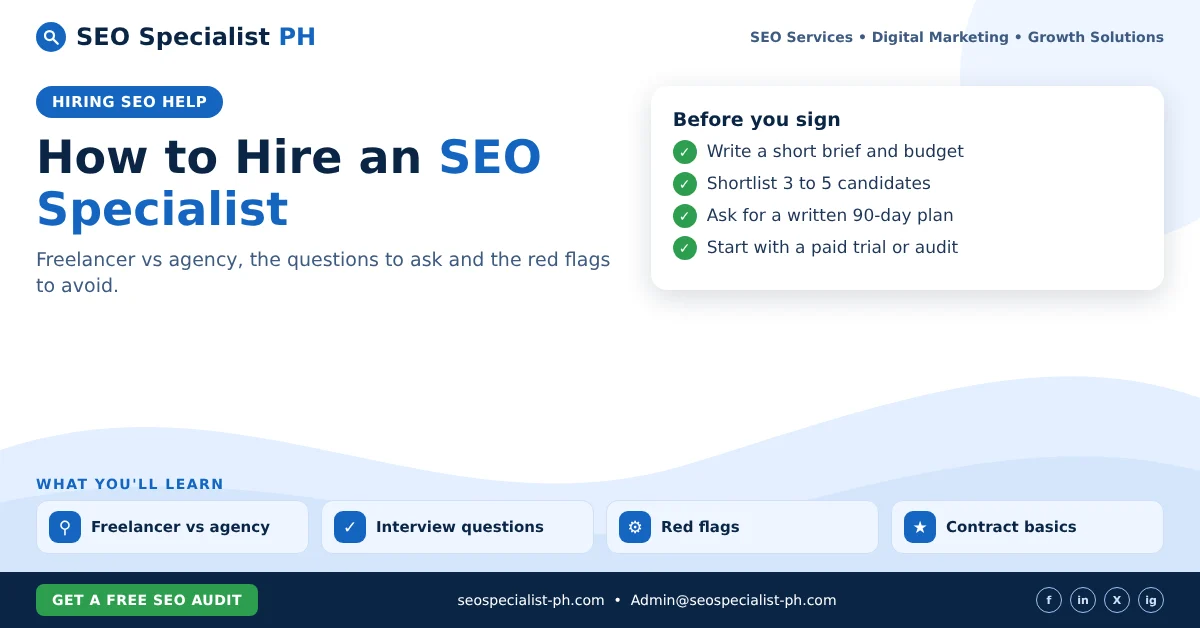
- Write a short brief. List your goals, your website, your market and what is already in place. Add a budget range and a start date.
- Shortlist three to five candidates. Look for relevant work in your industry or market.
- Run a structured interview. Use the questions in the next section and ask every candidate the same ones.
- Ask for a written plan. A good candidate explains what they would do in the first 30 to 90 days, and why.
- Start with a paid trial or audit. A small fixed-price project shows how they work before you commit to a retainer.
- Agree the scope in writing. Use a contract or statement of work, covered below.
Questions to ask before you hire
Google’s own guide, Do you need an SEO?, suggests asking candidates these questions:
- Can you show me examples of your previous work and share some success stories?
- Do you follow Google Search Essentials?
- What kind of results do you expect to see, and in what timeframe? How do you measure success?
- What is your experience in my industry, my country or city, and with international sites?
- How long have you been in business?
- How can I expect to communicate with you? Will you share every change you make and explain why?
Listen for specific answers. “We will build links” is vague. “We will fix the redirect chains on your service pages, then update three thin pages” is a plan. A good specialist will also ask about your business, your customers and your competitors.
Red flags when hiring SEO help
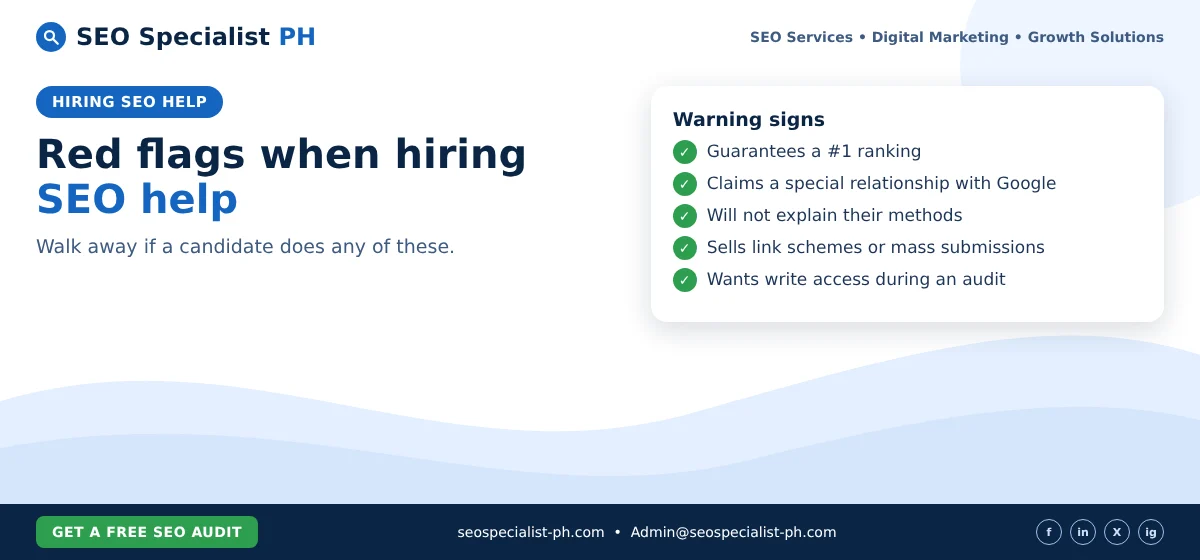
Google’s guide warns against several practices. Walk away if a candidate:
- Guarantees rankings. Google states that no one can guarantee a #1 ranking on Google.
- Claims a “special relationship” with Google or offers a “priority submit” service.
- Will not explain what they do. Secret methods are a warning sign, especially if they have access to your server.
- Sells link schemes or submission to thousands of search engines. Google calls these typically useless.
- Contacted you out of the blue. Google advises treating unsolicited SEO emails with the same scepticism as spam.
- Asks for write access during an audit. Read-only access is enough at that stage.
Also be careful with anyone who reports only on “keyword positions” they choose themselves. Ask to see results in your own Search Console and analytics instead.
Give access safely
You do not need to share your passwords. In Google Search Console, a property owner can add users from Settings > Users and permissions. Google’s help page on managing owners, users and permissions explains the three levels:
- Owner: full control, including adding and removing users.
- Full user: can view all data and take some actions.
- Restricted user: can view most data only.
For an audit, a restricted or full user is usually enough. For your website, create a separate account for the specialist rather than sharing your own login. Remove access when the work ends.
What to put in the contract
A clear statement of work prevents most disputes. Include:
- Deliverables: for example, one audit report, four articles a month or fixes to a list of pages.
- Reporting: what you will receive, how often, and which data sources it uses.
- Approvals: who signs off on changes before they go live.
- Ownership: content, reports and accounts created for you belong to your business.
- Notice period: how either side can end the agreement.
- No guarantees: a promise of specific rankings is itself a red flag, so do not ask for one.
Next steps
Knowing how to hire an SEO specialist well comes down to preparation. Start with a clear brief and a small paid project. Judge candidates on the plan they give you and the way they explain it. If you want a second opinion first, try our free SEO audit tool or read how technical SEO optimization works. You can also contact SEO Specialist PH to talk through what your site needs.
